PLS-GS: Probabilistic Lidar Scaffolds for
Compact, Surface-Aligned Gaussian Splatting

Krishnan Harikumar1, Alejandro Fontan1, Thierry Peynot1, Emili Hernández2, Niko Sünderhauf1
1QUT Centre for Robotics   2Emesent
WACV 2027
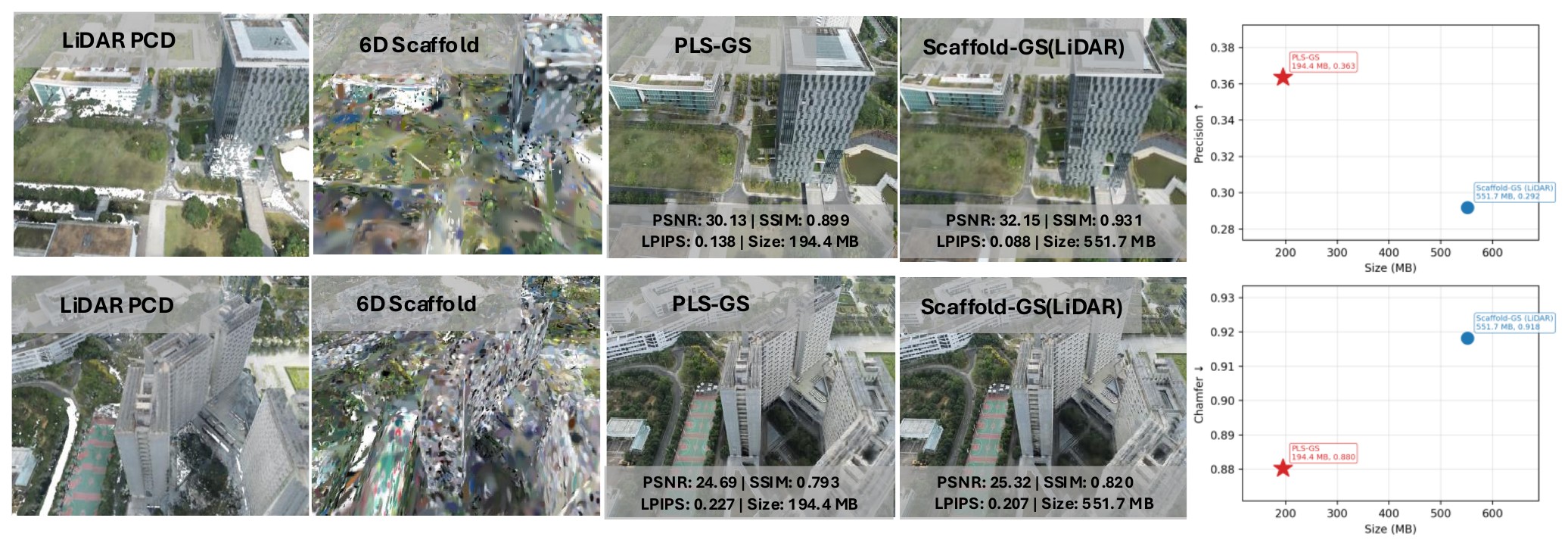
PLS-GS teaser: LiDAR point cloud, 6D HGMM scaffold, PLS-GS and Scaffold-GS (LiDAR) renders on the College scene

PLS-GS produces compact, surface-aligned scaffolds that place primitives closer to the measured surface. From the LiDAR point cloud and SfM input we build a continuous 6D HGMM scaffold whose anchors are surface-aligned, in contrast to the unstructured anchor set of Scaffold-GS. PLS-GS renders at 35% of the model size of the LiDAR-initialized baseline, with higher precision and lower Chamfer distance.
Abstract

While 3D Gaussian Splatting (3DGS) is typically optimized from images only, many robotics and mapping applications provide both camera and high-definition LiDAR data, combining rich visual appearance with accurate geometric structure. We introduce PLS-GS, a probabilistic LiDAR scaffold for Gaussian Splatting that exploits this complementary sensing setting to construct a compact 3DGS representation aligned to the measured surface. PLS-GS fits a Hierarchical Gaussian Mixture Model jointly over position and color, yielding a continuous and adaptive scaffold that eliminates the need for discrete scene partitioning such as voxel grids or octrees. The fitted mixture then guides the renderable 3DGS Gaussians: each rendering Gaussian is associated with a GMM component and constrained in the local surface frame induced by that component's covariance. A Mahalanobis support loss bounds the deviation of the rendering Gaussians from the corresponding LiDAR-derived surface. Across five large outdoor scenes, PLS-GS places primitives markedly closer to the LiDAR measurements than both image- and LiDAR-initialized baselines, while employing substantially fewer primitives, yielding a considerably more compact model and faster rendering. At matched capacity, PLS-GS places primitives closer to the LiDAR measurements, with comparable rendering quality.

Method

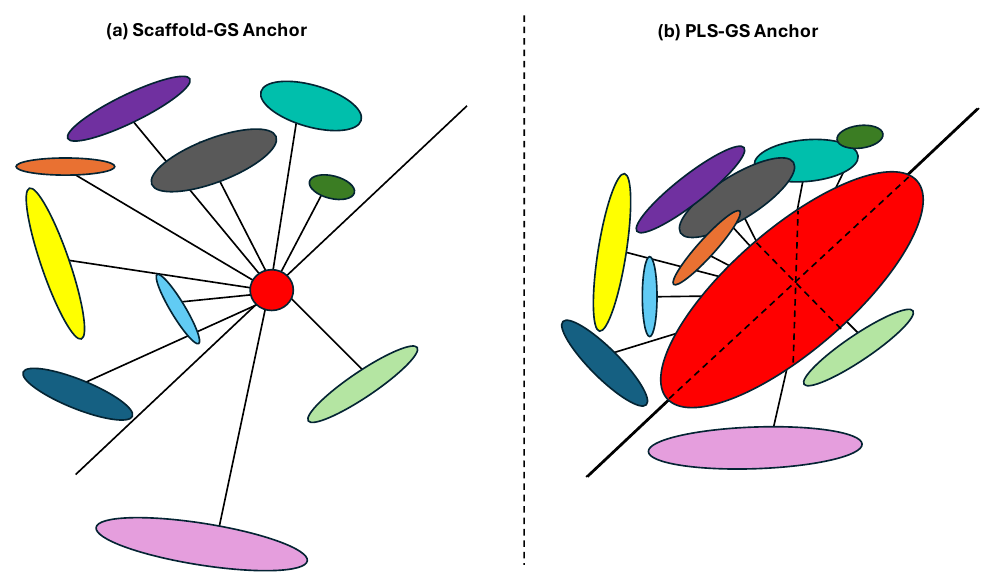
Scaffold-GS anchor versus PLS-GS surface-aligned anchor

Surface-aligned anchors. Scaffold-GS (left) anchors neural Gaussians at a point with world-axis offsets; PLS-GS (right) anchors them in the mixture component's eigenvector frame, aligning their spread with the local surface. A Mahalanobis support loss keeps them close to it.

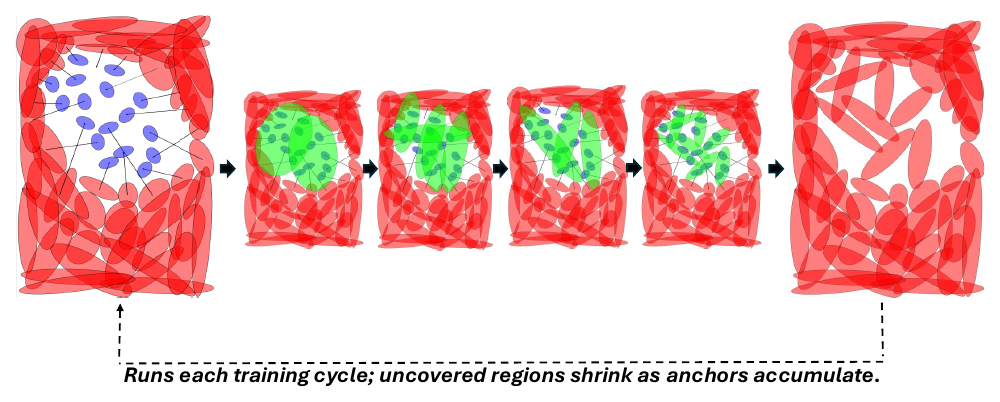
HGMM-based anchor growth over training cycles

HGMM-based anchor growth. Neural Gaussians spawned in regions left uncovered by the scaffold accumulate high photometric residual (blue). A local HGMM is fitted to them and its leaf components become new anchors (green), so uncovered regions shrink progressively over training.

Results

Mean over the five GauU-Scene V2 scenes. Both baselines are Scaffold-GS at its published configuration, differing only in the initialization cloud. Best in bold; per-scene results are in the paper.

MethodAnchorsPSNR↑SSIM↑LPIPS↓Precision↑Recall↑F1↑Chamfer↓FPS↑TrainSize (MB)↓
Scaffold-GS (SfM)1368K27.100.8640.1570.3120.1890.2340.899114.025:47432.5
Scaffold-GS (LiDAR)1308K26.480.8550.1610.3300.2450.2790.820114.425:09413.2
PLS-GS460K25.450.8170.2170.4840.1910.2690.703190.417:45172.9
Qualitative comparison on the College scene

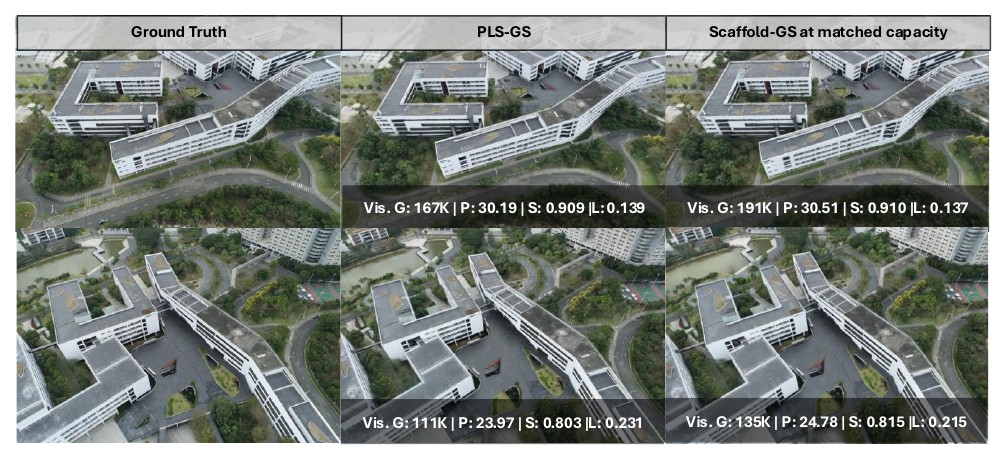
Matched capacity. Held-out views on the College scene rendered by PLS-GS and by Scaffold-GS initialized from the same anchors. With identical anchor sets the two render comparably, while PLS-GS places primitives closer to the LiDAR measurements.

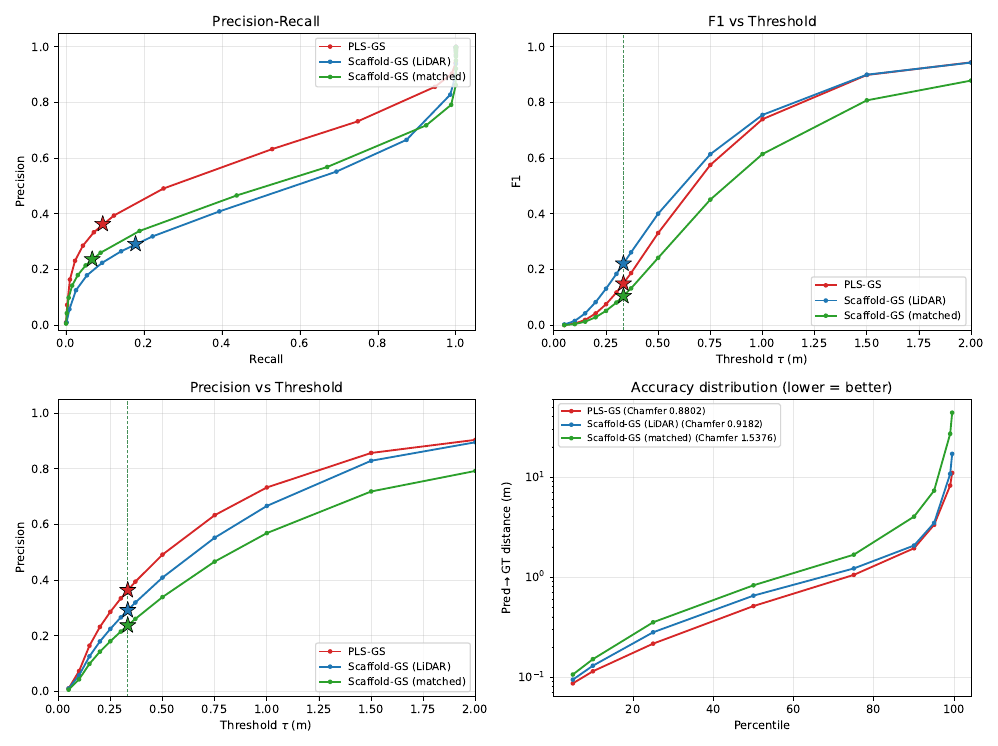
Precision-recall, F1, precision vs threshold and error distribution on the College scene

Geometric alignment on the College scene. PLS-GS (red) against the LiDAR-initialized baseline (blue) and that baseline at matched capacity (green). Stars mark the per-scene operating threshold.

Code

Code release is in preparation and coming soon at github.com/k-harikumar/PLS-GS.

BibTeX

@inproceedings{harikumar2027plsgs,
  title     = {{PLS-GS}: Probabilistic Lidar Scaffolds for Compact, Surface-Aligned Gaussian Splatting},
  author    = {Harikumar, Krishnan and Fontan, Alejandro and Peynot, Thierry and Hern{\'a}ndez, Emili and S{\"u}nderhauf, Niko},
  booktitle = {Proceedings of the IEEE/CVF Winter Conference on Applications of Computer Vision (WACV)},
  year      = {2027}
}

Acknowledgements

This work was supported by the Australian Research Council Research Hub in Intelligent Robotic Systems for Real-Time Asset Management (ARIAM) (IH210100030) and Emesent. The authors acknowledge the ongoing support from the Queensland University of Technology (QUT) Centre for Robotics.

Related Work

[Lu et al. 2024] Tao Lu, Mulin Yu, Linning Xu, Yuanbo Xiangli, Limin Wang, Dahua Lin, and Bo Dai. Scaffold-GS: Structured 3D Gaussians for View-Adaptive Rendering. CVPR, 2024.

[Xiong et al. 2024] Butian Xiong, Nanjun Zheng, Junhua Liu, and Zhen Li. GauU-Scene V2: Assessing the Reliability of Image-Based Metrics with Expansive Lidar Image Dataset Using 3DGS and NeRF. arXiv:2404.04880, 2024.

[Eckart et al. 2016] Benjamin Eckart, Kihwan Kim, Alejandro Troccoli, Alonzo Kelly, and Jan Kautz. Accelerated Generative Models for 3D Point Cloud Data. CVPR, 2016.